Client Access
  Communications
Introduction
Hello everyone,
First of all, my sincere apologies for the delay in publishing this quarterly newsletter. I wanted to take the time to sit down and properly summarize the corporate and financial developments of the past few months, time that I simply did not have. Note to self: tell my daughters to stop moving!
That being said, I am happy to begin with several pieces of good news. First, I am pleased to welcome Krysta Leduc to the team as Marketing Project Manager. We already have several ideas to further elevate the Rivemont brand, and you should begin to notice some exciting changes this summer in terms of content creation, particularly on social media. I would also like to remind you that Rivemont Investments is active on LinkedIn, Facebook, and now Instagram. So, if you are not following us yet, now is exactly the right time to do so.
I am also pleased to announce that, for the second consecutive year, we will be hosting a gathering for Rivemont clients and friends this fall. Please mark your calendars for October 22 for the Montreal region and October 29 for the Ottawa-Gatineau area. More details will follow shortly!
In this newsletter, I will discuss our investment approach by reviewing both our successes and our less successful decisions since the beginning of the year. I will then continue with a discussion on artificial intelligence, a topic I am passionate about because, in my opinion, we continue to underestimate its impact. As usual, we will conclude with our market outlook and our most significant portfolio positions.
Enjoy your reading!
Your Portfolio
A quick reminder of our approach to building our clients’ equity portfolios. First, we evaluate the market as a whole in order to identify the most attractive sectors. We then select the companies most likely to outperform the broader stock market. And for the past 15 years, this is exactly what we have managed to achieve.
However, active management comes with its share of challenges. The most important one, in my view, is that performance will differ from the benchmark index over periods that can sometimes be lengthy. Personally, I believe that five years represents the ideal minimum period to properly evaluate the quality of portfolio management.
Sector rotation, as we apply it, aims to benefit from the various themes emerging in the markets. In other words, to seize the opportunities the market offers us.
Our greatest success in this regard over the past 36 months has been the gold sector, although we currently no longer have exposure to it. Our main positions included Wheaton Precious Metals (WPM), Osisko (OR), Agnico Eagle Mines (AEM), and Franco-Nevada (FNV).
Let us now examine the short- and long-term impacts of this exposure.
GLD, Monthly and Daily Charts.
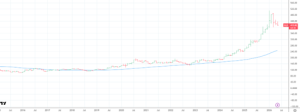
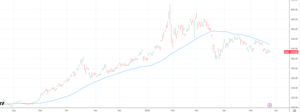
Source: TradingView
We purchased our initial positions during the bullish breakout in February 2024 and sold the last one in April of this year. The point I want to make here is that although gold was highly profitable for our clients over the entire period, it was much less so in the short term, specifically this year. In other words, it is important to step back and consider the full picture rather than focusing on a short time period.
Another challenge we face is portfolio volatility. One sector we partially missed is semiconductors, although we like our current approach, notably with Element Solutions (ESI) and SkyWater (SKYT) in our portfolios.
It has been proven that one of the best ways to maximize returns is to limit significant drawdowns. However, this sector is extremely volatile. Using SMH (VanEck Semiconductor ETF) as a reference, we can observe declines of 40% in 2024–2025 and 45% in 2022. Managing this volatility effectively will remain an important priority going forward.
One sector we currently particularly like is healthcare. And if IBB (iShares Nasdaq Biotechnology ETF) breaks above its all-time high, we expect fireworks!
IBB
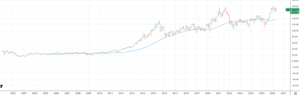
Source: TradingView
Gilead Sciences (GILD) and Jazz Pharmaceuticals (JAZZ) are among the positions we currently hold, in addition to our more traditional investments in senior residences and hospitals.
Artificial Intelligence
I currently place so much importance on artificial intelligence that my last two articles in Les Affaires focused on this topic. Here, I will attempt to summarize my perspective and its potential impact on the markets.
Let us step back for a moment to better understand why all of this is happening right now. The major models, Claude, Gemini, and ChatGPT, have now reached the third and final stage of their evolution, excluding the eventual arrival of artificial general intelligence or superintelligence.
By February 2026, all these models had demonstrated agency and multimodal capabilities allowing them, in simple terms, to autonomously execute tasks with reasoning abilities comparable to those of most humans. As Peter H. Diamandis and Steven Kotler explain very well in their recent book We Are as Gods, the business plan for the next ten thousand startups is easy to predict: take X and add AI.
When people ask me what inning we are currently in during this revolution, I often respond that the first inning has not even started yet, but that the national anthem has just ended, with fighter jets flying overhead. In other words, we are still in the process of building the infrastructure required to support these nearly infinite possibilities.
The implications of this revolution are countless, and the consequences for certain service businesses are already catastrophic. The best example remains Chegg (CHGG), the former global leader in tutoring and educational materials. It is now possible to ask ChatGPT to produce this type of content at virtually no cost to the user. The company’s stock, listed on the New York Stock Exchange, has fallen from over US$100 in 2021 to less than US$1 today.
The examples continue to multiply. In reality, all companies specializing in software production or data processing are facing significant pressure. In Canada, Constellation Software (CSU) has lost more than 50% of its value, while Thomson Reuters (TRI) has declined by more than 60%.
The end of February was also marked by the publication of a report by Citrini Research, which envisions a world where AI causes major job losses, leading to a collapse in discretionary consumer spending. Even Howard Marks, co-chairman of Oaktree Capital Management, stated that AI’s effects on the labor market could be profound and permanent.
On our side, while many advocate caution and patience, we chose the opposite path. Several months ago, we eliminated all positions that we believed were vulnerable to an irreversible AI disruption.
Our final survivor was IBM (IBM), which itself learned it was not immune: Anthropic announced that Claude could now understand and program in Cobol, an important source of revenue for Big Blue.
There will obviously be winners, and those who identify them quickly will be greatly rewarded. Much like in the late 1990s, when the foundations of the internet were being built, we are currently witnessing the physical construction of everything that will be required to support conversational agents and artificial intelligence systems over the coming years.
Back then, the infrastructure involved fiber optics and digital data management systems. The major beneficiaries were companies such as Cisco (CSCO), Nortel, WorldCom, and Alcatel-Lucent.
Today, the winners are the companies building the data centers required for the large language models used by Anthropic and OpenAI. Think of Nvidia (NVDA), AMD (AMD), and Micron (MU) in semiconductors, as well as data center operators such as Equinix (EQIX).
But as always, the further down the value chain you go, the more interesting the opportunities become. Companies such as nVent Electric (NVT) are essential for operating and securing these complex electrical systems. Element Solutions (ESI), for its part, protects and insulates electronic circuits.
As the well-known saying goes: sometimes, selling shovels and picks to miners can be just as profitable as mining itself.
Market Prospects
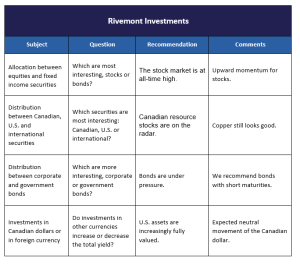
Favorite Securities
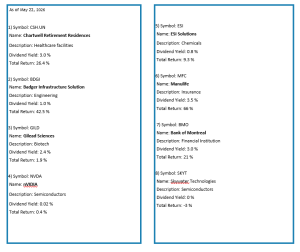
You will find below a list of the individual securities with the largest weight in our portfolios. These stocks were selected based on their respective potential to outperform the market. You will find a short description of their activities, the annual dividend, if any, and the total return since their first inclusion in our portfolio.
Conclusion
We are currently at an extremely interesting moment in the world of active financial management. Certain high-risk, high-octane funds and managers are generating excellent returns, but they obviously remain exposed to significant losses should valuations contract. Others, more focused on value investing, are significantly underperforming the market, as the train has already left the station and the gap relative to the indexes continues to widen.
I like to think that Rivemont currently positions itself as an optimal compromise between these two approaches: strong returns, but without excessive risk.
Wishing you plenty of sunshine!
Martin Lalonde, MBA, CFA
President