

 Client Access
  Communications
Introduction
Hello everyone,
Legendary investor Stan Druckenmiller has often said that his best periods were those when he felt deeply connected to the market, almost in perfect sync with it. Whenever he was able to read the market well, his strongest returns followed. I have to admit that I’ve been feeling somewhat the same way over the past few months.
Our portfolio is now positioned quite differently from the major market indices, and that is naturally where I would like to begin the main section of this newsletter. For several years now, we have consistently delivered the returns our investors expect while maintaining lower volatility than the broader market. In my view, this is a characteristic that will become increasingly valuable, as our analysis suggests that the coming years will bring a renewed interest in sectors that have largely been overlooked while technology and artificial intelligence have dominated investors’ attention. Who remembers 1999?
Beyond this discussion, we will also use this newsletter to explore a financial planning topic—more specifically, the ongoing debate between taking a salary or receiving dividends. As always, we will conclude with our market outlook and a review of our largest portfolio holdings.
Happy reading!
2026 – The Great Sector Rotation
Early in my career, I learned that the stock market rewards those who are willing to look beyond the immediate horizon and that opportunities always exist, even during market downturns. For example, while the Nasdaq and the S&P 500 collapsed in 2000 and 2001, the Canadian market, excluding Nortel, began a sustained rally led by the resource and financial sectors.
We anticipated a similar rotation, and it is now unfolding. In my latest article published in Les Affaires, which I invite you to read here, I present our investment thesis on the healthcare sector, a sector that we have overweighted aggressively. Interestingly, healthcare has proven to be more resilient and less volatile than the broader market indices, a characteristic that we particularly value in today’s environment.
Within the healthcare sector, we are particularly focused on healthcare real estate, pharmaceutical companies and biotechnology firms. For example, we currently hold Omega Healthcare (OHI) and CareTrust (CTRE), as well as Jazz Pharmaceuticals (JAZZ) and Exelixis (EXEL).
CareTrust (CTRE)
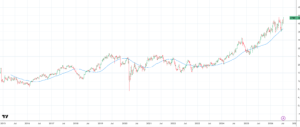
Source: TradingView
The second sector that continues to impress us is Canadian financials. Despite Canada’s fragile economy, the sector continues to benefit from the near-monopoly positions of many of its companies, allowing them to maintain exceptional profit margins while still trading at reasonable valuations. Bank of Montreal (BMO) and Manulife Financial (MFC) are examples of holdings we own in this sector, which has also historically been less volatile than the broader market.
That said, it is important not to get carried away. BMO has gained approximately 40% since January 1, an unusually strong performance. We are keeping a close eye on it.
Bank of Montreal (BMO)
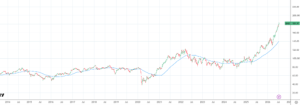
Source: TradingView
Salary or Dividend – A Tailored Approach
Par : Julien-Carl Landry
As financial planners, we are frequently asked by business owners how they should compensate themselves. Since a corporation is a separate legal entity, the income it earns belongs to the company. To use those funds personally, shareholders must pay themselves a salary, dividends, or a combination of both. The most appropriate choice depends on both the corporation’s tax situation and the owner’s personal objectives.
The Advantages of Dividends
Dividends provide considerable flexibility and are generally simple to administer. From a tax perspective, dividend income is typically taxed at a lower rate than employment income. In 2026, for example, in Quebec’s highest tax bracket, the marginal tax rate is approximately 40.1% for eligible dividends and 48.7% for non-eligible dividends, compared with 53.3% for salary income.
This comparison, however, does not tell the whole story, since dividends are paid from corporate profits that have already been taxed. Therefore, both the corporate tax paid by the company and the personal tax paid by the shareholder must be taken into account.
When dividends represent an individual’s only source of income, available tax credits can significantly reduce the overall tax burden. For example, in 2026, no personal income tax is payable on non-eligible dividends up to $40,299 federally and $21,807 provincially.
Finally, if the corporation has paid tax on investment income, it may recover up to 38.33% of that tax following the payment of dividends.
The Advantages of Salary
Salary contributes more directly to long-term financial security. It helps build retirement income while also providing access to certain social protection programs. Salary offers several advantages:
- It creates RRSP contribution room and allows taxes to be deferred until funds are withdrawn. This becomes particularly advantageous when your current tax rate is higher than the one you expect to face in retirement.
- It generates contributions to the Quebec Pension Plan (QPP), helping build an indexed retirement pension while providing disability and survivor benefits.
- It creates insurable earnings under the Quebec Parental Insurance Plan (QPIP) in the event of a birth or adoption.
- It may facilitate the federal childcare expense deduction.
- It may provide access to group insurance plans or employer-sponsored retirement plans offered by the corporation.
- For the corporation, salary is generally a deductible business expense that reduces taxable income.
Combining Salary and Dividends
A blended compensation strategy allows business owners to benefit from the advantages of both salary and dividends. An entrepreneur may first pay themselves enough salary to maximize RRSP contributions, contribute to the QPP, and generate insurable earnings under the QPIP. Additional cash flow needs can then be met through dividend payments.
In 2026, an annual salary of at least $85,000 is sufficient to reach the maximum QPP contribution level. Salary therefore helps build an indexed retirement pension while also allowing retirement savings to accumulate within an RRSP. This approach combines the financial security of salary with the flexibility of dividends, making it possible to tailor compensation to the shareholder’s personal circumstances.
Since the ideal balance depends on the corporation’s tax situation, family objectives and retirement plans, it should nevertheless be reviewed annually with qualified professionals.
Market Prospects
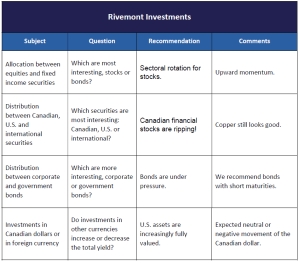
Favorite Securities
You will find below a list of the individual securities with the largest weight in our portfolios. These stocks were selected based on their respective potential to outperform the market. You will find a short description of their activities, the annual dividend, if any, and the total return since their first inclusion in our portfolio.
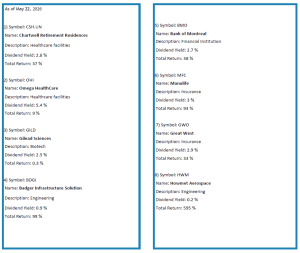
Conclusion
The first half of 2026 is now behind us and, so far, we have successfully avoided the most significant pitfalls. We believe our cash position remains somewhat higher than desired, and we are actively looking for opportunities to put that capital to work. At the same time, there are periods when preserving capital is just as important as identifying the next great investment opportunity.
In closing, we have several exciting projects planned for this fall, particularly across our social media platforms.
Stay tuned!
Wishing you, again, plenty of sunshine.
Martin Lalonde, MBA, CFA
President


